There’s a unique joy in sharing a freshly brewed cup of coffee with loved ones, or perhaps indulging in multiple cups yourself without the constant need for a refill. For those moments when a standard size just won’t cut it, the Large French Press Coffee Maker steps in as your ultimate brewing companion. It’s more than just a bigger pot; it’s an invitation to elevate your communal coffee experience, offering both capacity and unparalleled control over your brew. Whether you’re hosting a brunch, fueling a busy morning household, or simply can’t get enough of that rich, full-bodied flavor, understanding the nuances of a large French press can transform your coffee routine.
The Allure of Size: Why a Large French Press Reigns Supreme
Opting for a larger French press isn’t just about making more coffee; it’s about unlocking a host of advantages that enhance both the brewing process and the final cup.
Serving a Crowd with Ease
Imagine the scenario: friends gathered, laughter filling the air, and the aroma of freshly brewed coffee wafting from a single, generous vessel. A large French press is an entertainer’s dream, effortlessly producing enough coffee for several people without the hassle of multiple brewing cycles. It means more time enjoying company and less time fussing in the kitchen. For a bustling family breakfast, it’s equally invaluable, ensuring everyone gets their morning fix simultaneously.
Unlocking Richer Flavors and Aromas
One of the signature benefits of French press brewing is its ability to preserve the coffee’s natural oils and fine particulates, which paper filters often strip away. This immersion method allows for a more complete extraction, resulting in a coffee with a deeper, more robust flavor profile and a luxurious, silky mouthfeel. With a large French press, you’re not just getting more volume; you’re often getting a more consistent and complex flavor across the entire batch, as the larger water volume can contribute to a more stable brewing temperature.
Unmatched Control Over Your Brew
The French press is a manual brewer, putting you in the driver’s seat. A larger capacity can actually simplify this control. With more water and coffee involved, minor fluctuations in water temperature or steeping time have less dramatic effects on the overall outcome, making it more forgiving. You have precise command over the water temperature, the coffee-to-water ratio, and the steeping duration, allowing you to fine-tune each brew to your exact preferences. This level of customization ensures that every cup from your large French press coffee maker is exactly as you like it.
An Eco-Friendly Choice
In an age where sustainability is more important than ever, the French press shines as an environmentally conscious brewing method. By eschewing disposable paper filters and plastic pods, a durable French press significantly reduces waste. It’s a simple, elegant way to enjoy your coffee while being kind to the planet, brew after delicious brew.
Demystifying French Press Sizes: What “Cups” Really Mean
When you look at French press packaging, you’ll often see sizes listed in “cups” – a term that can be a bit misleading. Most manufacturers define a “cup” as approximately 4 ounces (about 120 mL). However, the average coffee mug in your home typically holds 8 to 16 ounces. This discrepancy is crucial when selecting your large French press coffee maker.
Generally, a French press labeled as an “8-cup” model will hold around 34 fluid ounces, which translates to about 2 to 4 standard coffee mugs. A “12-cup” French press, on the other hand, usually boasts a capacity of 51 fluid ounces or more, providing enough for 4 to 8 generous mugs of coffee. Understanding this difference ensures you pick a size that truly meets your needs, whether for daily personal enjoyment or larger social gatherings.
Choosing Your Perfect Large French Press Coffee Maker: A Buyer’s Guide
Selecting the right large French press is about more than just capacity. Several key factors contribute to its performance, durability, and overall user experience.
Material Matters: Glass, Stainless Steel, and Ceramic
The material of your French press carafe plays a significant role in both its functionality and aesthetics:
- Glass: Classic and elegant, glass carafes allow you to visually appreciate the brewing process, from the initial bloom to the rich color of the coffee. However, they are more fragile and tend to lose heat faster than other materials, which might be a consideration when brewing larger batches.
- Stainless Steel: Known for its exceptional durability and superior heat retention, stainless steel French presses are a robust choice. Double-walled, vacuum-insulated stainless steel models are particularly effective at keeping your coffee hot for extended periods, perfect for a large French press coffee maker meant for lingering enjoyment or serving multiple rounds. They are also less prone to breakage, making them a good investment.
- Ceramic: Offering a unique aesthetic appeal, ceramic French presses retain heat well and can be quite durable. However, they are typically heavier and can be more expensive.
The Power of Filtration: Minimizing Sediment
While a characteristic of French press coffee is its rich, full-bodied nature, some fine sediment is also expected. The quality of the filtration system significantly impacts how much grit ends up in your cup. Look for models with finely woven mesh filters, sometimes featuring double or even triple layers, designed to trap more grounds while allowing those precious coffee oils to pass through.
Keeping it Hot: The Importance of Heat Retention
For a large French press, heat retention is paramount. Brewing a large batch means the coffee will sit for longer, especially if you’re pouring multiple servings. A French press that can maintain a consistent, hot temperature throughout the brewing and serving process ensures a better-tasting cup from start to finish. Double-walled stainless steel designs excel in this area, keeping your coffee piping hot without continuous reheating.
Design and Durability
Consider the overall construction, handle comfort, and spout design for easy pouring. A well-designed large French press coffee maker should feel sturdy and balanced in your hand, even when full.
Brewing Perfection: A Step-by-Step Guide for Your Large French Press
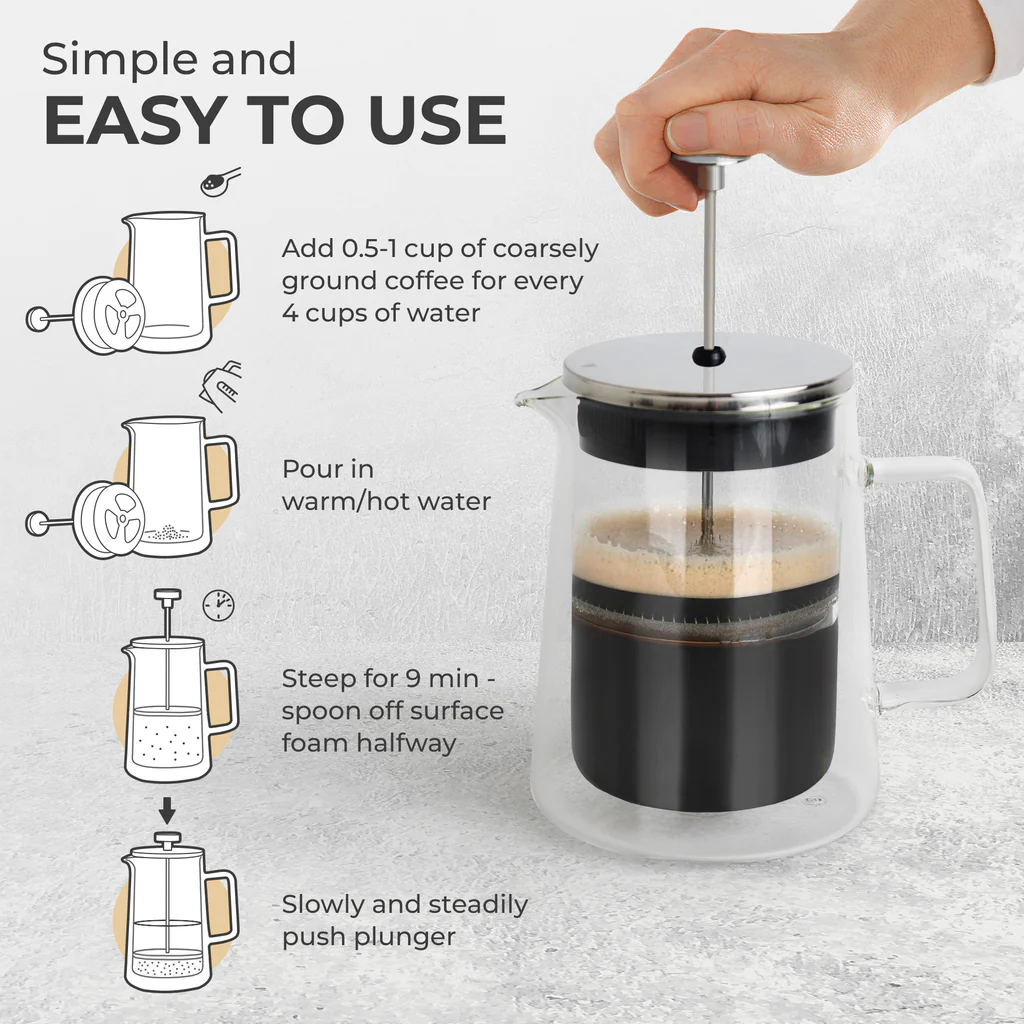
Mastering the large French press is a simple, satisfying process. Follow these steps for a consistently delicious brew:
Step 1: Preheat and Measure
Always start by preheating your French press carafe with hot water. This prevents the brewing water from cooling too quickly, ensuring optimal extraction. For a rich, full-bodied cup, a good starting point for your coffee-to-water ratio is 1:15 (e.g., 60 grams of coffee for 900 ml of water). Measure your freshly roasted beans accurately.
Step 2: Grind Coarsely
The French press thrives on a coarse, even grind, similar to breadcrumbs. A grind that is too fine will pass through the filter, resulting in a silty cup and potential over-extraction. Use a burr grinder for the most consistent results.
Step 3: The Bloom and Steep
Once your water is just off the boil (around 200°F / 93°C), pour a small amount over the grounds, just enough to saturate them. This is the “bloom,” where CO2 escapes, preparing the coffee for extraction. Let it sit for about 30 seconds. Then, pour the remaining hot water evenly over the grounds. Place the lid on top with the plunger pulled up, and let it steep for 4 minutes. Some prefer 3 or 5 minutes, so feel free to experiment with what you like best.
Step 4: Press and Pour
After steeping, slowly and steadily press the plunger straight down, using consistent pressure. Avoid pressing too quickly, as this can force fine particles through the filter. Once pressed, pour your coffee immediately to prevent over-extraction, which can lead to bitterness.
Elevate Your French Press Experience: Tips & Tricks
Even with a large French press, small details can make a big difference in your brew.
- Water Quality & Temperature: Always use filtered water for the cleanest taste. Aim for water that’s just off the boil, around 200°F (93°C). Too hot, and you risk burning the coffee; too cool, and you’ll under-extract.
- Grind Consistency: This is key. An inconsistent grind leads to uneven extraction, where some particles are over-extracted and others under-extracted. Invest in a quality burr grinder for the best results.
- Don’t Over-Extract: Once the coffee is plunged, it’s best to pour it out. Leaving brewed coffee in contact with grounds, especially in an insulated press, can lead to continued extraction and a bitter taste. If you’re not serving it all at once, transfer the extra coffee to a preheated carafe.
- Experiment with Ratios: While 1:15 is a great starting point, your ideal coffee-to-water ratio might vary based on your beans and personal preference. Don’t be afraid to adjust slightly to find your perfect cup.
Beyond Coffee: Versatile Uses for Your Large French Press
Your large French press coffee maker is a multi-talented kitchen tool, capable of more than just brewing coffee.
Cold Brew Concentrate
A large French press is perfect for making cold brew concentrate. Simply add coarsely ground coffee and cold, filtered water, stir gently, and steep in the refrigerator for 12-24 hours. Press, and you’ll have a smooth, low-acid concentrate ready for dilution with water, milk, or ice.
Loose-Leaf Tea
It works wonderfully as an oversized tea infuser for loose-leaf teas. Add your favorite tea leaves, hot water, steep for the recommended time, and then press. The plunger effectively separates the leaves, giving you a clean, delicious brew for several servings.
Milk Frother
Believe it or not, a French press can even froth milk! Heat milk in a saucepan, pour it into the French press (filling about halfway), and then vigorously pump the plunger up and down until you achieve your desired foam consistency. It’s a simple way to create barista-quality frothed milk for lattes and cappuccinos.
Care and Maintenance for Longevity
To ensure your large French press coffee maker continues to deliver outstanding brews for years to come, proper cleaning is essential.
Daily Cleaning
After each use, discard the grounds and rinse the carafe and plunger with warm water. A soft sponge and a mild dish soap are usually sufficient. For glass carafes, be gentle. For stainless steel, ensure all oils are removed to prevent residue buildup.
Deep Cleaning the Filter
Periodically, you’ll want to disassemble the filter screen(s) and clean them thoroughly to remove any trapped coffee fines or oils. A small brush can be helpful for this task. Ensure all parts are completely dry before reassembling.
Expert Insights on Large French Press Brewing
“Brewing with a large French press offers a generous canvas for flavor exploration,” says Anya Sharma, a seasoned barista and coffee consultant. “The increased volume allows for a more stable extraction environment, meaning you can achieve exceptional depth and consistency across multiple cups. It truly shines when you’re looking to create a shared coffee experience, without compromising on quality or flavor.”
Frequently Asked Questions About Large French Press Coffee Makers
How many “real” cups of coffee does a 12-cup French press make?
A 12-cup French press typically yields 4 to 8 standard 8-ounce mugs of coffee, depending on how full you fill them. Manufacturer “cups” are usually 4 ounces.
Is a large French press harder to clean than a small one?
While larger, the cleaning process is fundamentally the same: rinse, wash with soap, and occasionally deep clean the filter. The main difference might be handling the larger carafe, but it’s generally not more difficult.
Can I make a smaller batch of coffee in a large French press?
Yes, you can absolutely brew smaller batches in a large French press. Simply adjust your coffee grounds and water volume proportionally to your desired yield.
Does the material of a large French press affect the taste of the coffee?
The material itself doesn’t directly affect the taste as much as its ability to retain heat. Stainless steel, especially double-walled, keeps water hotter longer, which can lead to a more consistent extraction and potentially a better-tasting cup. Glass offers visual appeal but may cool faster.
What’s the best grind size for a large French press coffee maker?
A coarse, even grind, similar to sea salt or breadcrumbs, is ideal. This prevents excessive sediment and over-extraction, ensuring a clean and flavorful brew.
The Grand Finale: Your Large French Press Journey Awaits
The large French press coffee maker stands as a testament to simple elegance and robust flavor. It’s a tool that empowers you to create exceptional coffee, not just for yourself, but to share with others, fostering connections over every rich, aromatic sip. From its historical roots to its modern applications, the French press offers a direct, unadulterated coffee experience that many coffee aficionados cherish. Embrace the capacity, revel in the control, and let your large French press be the centerpiece of countless memorable coffee moments. So go ahead, experiment with your favorite beans, perfect your technique, and discover the expansive world of French press brewing. Your perfect, big-batch cup awaits!