Ah, the French press. It’s more than just a coffee maker; it’s a ritual, a moment of calm, and for many, the definitive way to start the day. In a world of fleeting coffee trends, the French press stands as a steadfast anchor in kitchens worldwide, especially the beloved 1-liter size. Often dubbed the “Goldilocks” of coffee brewers, a 1L French press strikes that perfect balance, offering enough rich, full-bodied coffee for a couple of generous mugs to share, or a delightful solo session that fuels your morning.
But what makes the 1L French press so special, and how can you unlock its full potential? This comprehensive guide will take you through everything you need to know, transforming your daily brew into an exceptional coffee experience.
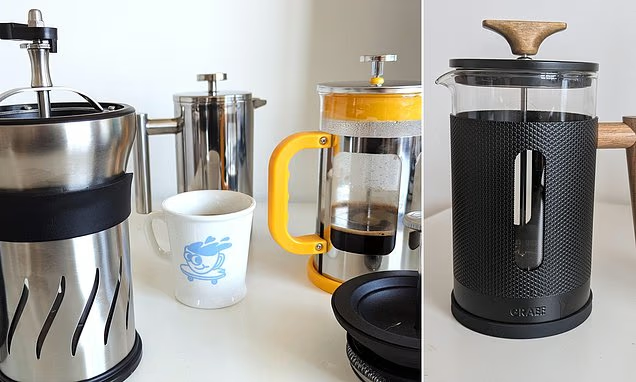
The Enduring Legacy of the French Press
A Brief History of a Brewing Icon
The French press, or “cafetière” as it’s known in some parts, has a history as rich and robust as the coffee it brews. While its exact origins are debated, its popularity surged in post-war Europe. People sought a simple, reliable method to make quality coffee at home, and the French press, with its elegant design and straightforward operation, quickly became a household staple.
Why the 1L French Press Became the Standard
To truly understand the dominance of the 1L French press, we need a quick dive into coffee history and measurement. When the device first gained widespread popularity, the standard measure for a “cup” of coffee was a small demitasse, typically around 4 ounces (about 120ml). Manufacturers, aiming to provide a suitable size for an average household, settled on a volume that could serve roughly eight of these smaller cups. Do the math: 8 “cups” x 4oz = 32-34oz, which translates almost exactly to 1 liter in metric terms.
Fast forward to today, and our coffee habits have evolved. A “cup” of coffee now often means a generous 10-12oz mug. So, while often marketed as an “8-cup” press, a 1L French press (approximately 34 fluid ounces) perfectly yields about two very generous 17oz mugs, or three standard 11oz mugs, making it incredibly versatile for modern homes.
Why Choose a 1L French Press?
The “Goldilocks” Capacity for Every Home
The 1L French press truly is the ideal size. It’s not so small that you’re constantly wishing for more, nor is it so large that you’re brewing industrial quantities. It’s just right for:
- Sharing: Perfect for two people enjoying breakfast together or a small gathering.
- Solo Indulgence: Provides ample coffee for one person who savors multiple cups throughout the morning or needs a significant caffeine boost for a productive work session.
Unparalleled Flavor and Body
One of the greatest appeals of the French press method is its full immersion brewing. Unlike drip coffee makers where water passes through grounds quickly, the French press allows coffee grounds to steep directly in hot water for an extended period. This results in a rich, full-bodied cup with a velvety texture and complex flavors that are often filtered out by paper in other methods.
Simplicity Meets Sophistication
Despite its ability to produce sophisticated flavors, the French press remains remarkably simple to use. There are no complicated electronics, no fancy programming, just a timeless design that relies on the fundamental principles of extraction. It’s a method that invites you to be present in the brewing process.
Essential Components of Your 1L French Press
Decoding the Design
A French press is elegantly simple, typically consisting of:
- The Carafe: The main vessel where coffee steeps. For a 1L model, this holds approximately 1000ml of water.
- The Plunger: A rod with a mesh filter attached to the end. This is used to separate the spent coffee grounds from the brewed coffee.
- The Lid: Helps retain heat during the brewing process.
Glass vs. Stainless Steel: A Matter of Performance
While many traditional French presses feature a glass carafe, there’s a significant upgrade that serious coffee lovers should consider for their 1L model: double-walled stainless steel.
Glass, though aesthetically pleasing, has a “thermal mass problem”. When you pour hot water into a cold glass carafe, the glass rapidly absorbs heat, instantly dropping your brewing temperature below the optimal range. Glass is also a poor insulator, causing heat to radiate outwards quickly. This often leads to under-extracted coffee that tastes sour or thin, and your second cup might be disappointingly lukewarm.
A double-walled stainless steel French press, however, employs vacuum insulation—the same technology found in high-end thermal flasks. This ensures your water temperature remains stable throughout the entire steep, leading to a richer, more complete extraction. Plus, it acts as a thermal carafe, keeping your coffee piping hot for over an hour after brewing, and it’s virtually indestructible!
Crafting the Perfect Cup: A Step-by-Step Guide for Your 1L French Press
Brewing a full liter of coffee requires a bit of precision, but the payoff is immense.
What You’ll Need:
- Your 1L French press
- Freshly roasted coffee beans
- A burr grinder (for consistent grind size)
- A digital scale (for accurate measurements)
- A kettle with temperature control (or a thermometer)
- A timer
- A long spoon or stirrer
Step-by-Step Brewing Process:
- Pre-heat Your French Press: Fill the empty carafe with hot water from your kettle and let it sit for about a minute. This prevents thermal shock and helps maintain a stable brewing temperature. Discard the water.
- Measure and Grind Your Coffee: For a 1L French press, we recommend a ratio of 1:15 to 1:16 coffee to water. This means for 1000ml of water, you’ll need 60 to 65 grams of whole bean coffee. Grind your beans to a medium-coarse consistency, resembling coarse sea salt. Too fine, and your coffee will be bitter and hard to plunge; too coarse, and it will be weak.
- Add Ground Coffee: Place your French press on the digital scale, tare it to zero, and add your precisely measured coffee grounds.
- Add Hot Water: Heat your water to between 195°F and 205°F (90°C – 96°C). This is typically about 30 seconds off a rolling boil. Pour the water slowly and evenly over the grounds, ensuring they are all saturated.
- The Bloom (Optional but Recommended): Pour about 150ml of water, stir gently to ensure all grounds are wet, and let it sit for 30-45 seconds. You’ll see the coffee “bloom” as CO2 escapes, which can lead to a more even extraction.
- Fill and Steep: Pour the remaining water to fill your 1L French press up to the metal band, or to your desired volume. Place the lid on top, but do not plunge yet. Start your timer.
- Steep to Perfection: Let the coffee steep for 4 minutes. Some prefer slightly longer, up to 6-7 minutes, for an even bolder brew. Experiment to find your sweet spot.
- The Gentle Plunge: After the steeping time, slowly and gently press the plunger down. The key is a smooth, controlled motion. If you feel too much resistance, pull up slightly and try again; never force it. Stop pressing once the plunger reaches the bottom.
- Serve Immediately: Pour your freshly brewed coffee into your favorite mugs. While a stainless steel French press acts as a thermal carafe, it’s generally best to separate the coffee from the grounds as soon as it’s brewed to prevent over-extraction and bitterness.
Elevating Your French Press Experience: Expert Tips and Tricks
The Grind Size Debate: Finding Your Sweet Spot
While some traditional advice leans towards a very coarse grind, modern thinking, especially for a 1L capacity, often points to a medium-coarse grind, similar to coarse sand or sea salt. This ensures a thorough extraction without excessive bitterness. The best approach is to experiment: if your coffee tastes weak, try a slightly finer grind; if it’s bitter and sludgy, go a little coarser.
Water Temperature Matters
Aim for water between 195°F and 205°F (90°C – 96°C). Water that’s too hot can scorch the coffee and lead to bitterness, while water that’s too cool will result in under-extraction and a weak, sour taste. If you don’t have a temperature-controlled kettle, simply let boiling water sit for 30-60 seconds before pouring.
Timing is Everything
A typical steep time is 4 minutes. However, this is a starting point. If you prefer a stronger, more intense cup, you might extend it to 5 or even 6 minutes. Shorter steep times (e.g., 3 minutes) can yield a lighter, brighter cup.
Coffee-to-Water Ratio: The Golden Rule
The widely accepted “golden ratio” for French press is around 1:15 to 1:16 (coffee to water). For your 1L French press, this means 60-65 grams of coffee for 1000ml of water. Using a digital scale is crucial for consistency.
The Art of the Gentle Plunge
Resist the urge to aggressively push the plunger down. A slow, steady, and gentle plunge (taking about 15-20 seconds) minimizes disturbance of the coffee bed and prevents fine particles from bypassing the filter, resulting in a cleaner cup.
“The 1L French press isn’t just about capacity; it’s about consistency,” shares barista Emily Chen. “Its larger volume allows for a more stable temperature throughout the brew, leading to a richer, more uniform extraction compared to smaller brewers.”
Freshness is Key
Always use freshly roasted, whole bean coffee and grind it just before brewing. Oxygen is coffee’s enemy, and pre-ground coffee quickly loses its aromatic compounds, leading to a duller brew.
Caring for Your 1L French Press
Proper care ensures your French press lasts for years and consistently delivers delicious coffee.
Cleaning for Longevity and Taste
After each use:
- The Daily Rinse: Scoop out the majority of the spent grounds (compost them if possible!). Add a little water, swish, and pour the remaining grounds and water into the compost or trash (avoid pouring large amounts down the sink to prevent clogs). Rinse the carafe and plunger assembly thoroughly with hot water.
- The Deep Clean: Once a week, fully disassemble the plunger and mesh filter. Wash all parts with warm water and a mild dish soap. This removes residual coffee oils that can turn rancid and affect flavor.
Storage Tips
Ensure all parts are completely dry before reassembling and storing to prevent mildew or odors. Store it in a safe place where it won’t be knocked over, especially if you have a glass model. Many stainless steel models are dishwasher safe, offering even easier sanitization.
Beyond Coffee: Creative Uses for Your 1L French Press
Your 1L French press is a versatile tool that can do more than just brew coffee!
Brewing a Brilliant Cold Brew
The 1L French press is perfect for making cold brew concentrate. Use a coarser grind, a higher coffee-to-water ratio (e.g., 80-100g of coffee for 1L of cold water), stir well, and let it steep in the refrigerator for 12-24 hours before plunging. You’ll get a smooth, low-acid concentrate that can be diluted with water or milk.
Crafting Flavorful Loose-Leaf Tea
It works wonderfully for loose-leaf teas. Place your desired amount of tea leaves in the carafe, add hot water (at the appropriate temperature for your tea), steep, and then plunge to separate the leaves.
Infusing Oils and More
You can even use your French press to infuse oils with herbs, create flavored water, or make homemade nut milks. The plunger acts as an excellent strainer for various infusions.
FAQ: Your Top 1L French Press Questions Answered
Q: How much coffee do I use for a 1L French press?
A: For a balanced, robust brew in a 1L French press, we recommend using between 60g and 65g (approximately 2.1 – 2.3 oz) of coarse-ground coffee. This follows the standard 1:15 to 1:16 coffee-to-water ratio.
Q: What grind size is best for a 1L French press?
A: A medium-coarse grind, similar to sea salt or coarse sand, is generally best. This allows for optimal extraction during the longer steep time of a French press, preventing bitterness from over-extraction and ensuring a smooth plunge.
Q: How long should I steep coffee in a 1L French press?
A: A typical steep time is 4 minutes, but you can adjust this to your preference. For a stronger brew, steep for 5-6 minutes. For a lighter cup, 3 minutes might suffice. Always taste and adjust.
Q: Is a 1L French press the same as an 8-cup?
A: Yes, generally. A 1L French press holds approximately 34 fluid ounces, which historically equates to “8 cups” based on older, smaller 4oz demitasse cup measurements. In modern terms, it typically yields 2-3 generous mugs of coffee.
Q: Can I make cold brew in a 1L French press?
A: Absolutely! A 1L French press is an excellent vessel for cold brew. Use 80-100g of very coarse coffee, fill with cold water, stir, and refrigerate for 12-24 hours before plunging and enjoying your concentrate.
Conclusion
The 1L French press is a truly timeless brewing device, celebrated for its ability to produce incredibly flavorful, full-bodied coffee with remarkable simplicity. Its generous capacity makes it the perfect centerpiece for daily rituals, whether you’re fueling your solo adventures or sharing a moment with loved ones. By understanding the nuances of grind size, water temperature, and steep time, and by considering the benefits of modern materials like insulated stainless steel, you can elevate your brewing game and consistently achieve a truly exceptional cup. So, embrace the art of the French press, experiment with your technique, and savor every rich, aromatic drop. Your perfect cup awaits.